WELCOME to the Stashing Sisters Website
Dedicated to all who love fabric and have a little ‘stash’ of their own.
Make sure and check out our latest posts and upcoming events.

Make sure and check out our latest posts and upcoming events.

The Young Women’s church group helped make this beauty of a quilt as a ‘thank you’ to their leader. Using strips of fabric known as “Jelly Rolls”, they sewed different colors together as strips, cut them and sewed them together again.
The final pieces were collected, sashed, quilted and bound by Amy.

Here’s a quilt project that’s a cutie. It’s a table topper of apples and jars of applesauce that is both hand and machine quilted. Emily made this for her mom’s table in remembrance of their family picking local apples and making applesauce. The colors are remarkably accurate for the pink applesauce and were chosen by her keen eyed husband.
Since the project was small, Emily decided to incorporate hand quilting for the diagonal lattice pattern, giving it charm. The long arm was used to quilt the borders. Note the hand embroidered apple stems on the quilted table runner.
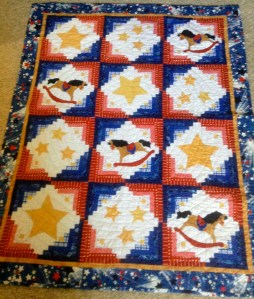
Colleen visited her stash and came up with 2 new projects. She made the first project for a new grandchild.
She says, “This quilt is for my new grandson. He is the 4th boy, and they live in Texas. I thought he needed a Texas themed quilt, so I put on horses and Texas stars.
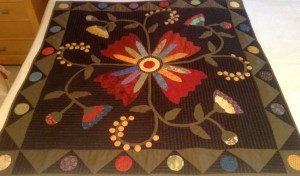
She describes the second project:
Last fall my sisters and I signed up to take a class from Kim Diehl on appliqué. I got sick and had to come home early and missed the class on this quilt, “Bittersweet Briar”. I already had purchased the background and the green, so I started in January and finished it this Spring. All the other fabrics are scraps and a few fat quarters I purchased. It was my first attempt at a primarily appliquéd quilt. Kim had a tan background, but I switched to a black one. I quilted in between the stripes in the background, and loved the way it turned out.
Thanks for sharing Colleen.
Why the unusual colors for a wedding quilt? Debbie made this red, white, and blue quilt at the request of a friend soon to be married. Several years ago, Debbie and her family hosted their new friend in the U.S. as a foreign exchange student from Germany for a year.
So what’s the big deal about a stash? We’d like to know from you why and how you stash.
Cathy Miller shares her stashing ideas in the following song/video :
This quilt was crafted in the 50’s. Very cute but not real complicated. The quilter appliqued the raw cut edges with a buttonhole stitch. On close observation it appears that the edges were later zigzagged (sewn on a sewing machine) as to prevent raveling. There is no batting making this a great bed topper or summer quilt. The backing is a pink plaid flannel. Visit MyKindredTree.com for more information on the maker of this quilt.
I wanted a project to do with my granddaughter when she came for an extended visit this summer. I suggested we make a quilt together and she readily agreed. She choose a quilt design she saw on the internet. We altered it a bit to fit a twin bed. We had fun looking through my stash of fabrics. We found several pieces we liked but needed more. A trip to the Hobby Lobby offered a new array of fabrics and the color scheme morphed as Adelle found some colors that she really liked.
Adelle helped cut the shapes and positioned them very carefully according to how she thought they looked best. She helped sew a bit too. We loaded it onto the long arm. It turned out great!
Assemble an assortment of different novelty fabric squares. The fabric should contain images of items that children could recognize. Squares can range from 2″ to 8″ depending on size of quilt and the number of individual fabrics you have. For example, a baby size quilt might need 48 five inch squares plus 1 1/4 yard of border fabric. That’s 48 different fabrics (you might want to find a buddy to share fabrics with on this one) .
Assemble squares 6 across and 8 down. Add the border around it. Embroider the names of the items to be found in the border. This could be done by hand, machine, or drawn with fabric marker.